
Favorites
Excerpt by Tracy Chou via Quartz
In 2005, the late writer David Foster Wallace delivered a now-famous commencement address. It starts with the story of the fish in water, who spend their lives not even knowing what water is. They are naively unaware of the ocean that permits their existence, and the currents that carry them.
The most important education we can receive, Wallace goes on to explain, “isn’t really about the capacity to think, but rather about the choice of what to think about.” He talks about finding appreciation for the richness of humanity and society. But it is the core concept of meta-cognition, of examining and editing what it is that we choose to contemplate, that has fixated me as someone who works in the tech industry.
As much as code and computation and data can feel as if they are mechanistically neutral, they are not. Technology products and services are built by humans who build their biases and flawed thinking right into those products and services—which in turn shapes human behavior and society, sometimes to a frightening degree…
But it is never too late to be curious. Each of us can choose to learn, to read, to talk to people, to travel, and to engage intellectually and ethically. I hope that we all do so—so that we can come to acknowledge the full complexity and wonder of the world we live in, and be thoughtful in designing the future of it.
From
Excerpt from The Atlantic — October 2014
The U.S. has its own tradition of apprenticeship going back many years. But like most kinds of vocational education, it fell out of fashion in recent decades—a victim of our obsession with college and concern to avoid anything that resembles tracking.
Today in America, fewer than 5 percent of young people train as apprentices, the overwhelming majority in the construction trades. In Germany, the number is closer to 60 percent—in fields as diverse as advanced manufacturing, IT, banking, and hospitality. And in Europe, what’s often called “dual training” is a highly respected career path….
[In Germany,] both employers and employees want more from an apprenticeship than short-term training… “In the future, there will be robots to turn the screws,” one educator told us. “We don’t need workers for that. What we need are people who can solve problems”—skilled, thoughtful, self-reliant employees who understand the company’s goals and methods and can improvise when things go wrong or when they see an opportunity to make something work better…
What makes dual training work, every manager told us, are the standardized occupational profiles, or curricula, developed by the federal government in collaboration with employers, educators, and union representatives…

Through advanced data analytics and visualization, DataUSA tells stories about: places in America—towns, cities and states; occupations, from teachers to welders to web developers; industries — where they are thriving, where they are declining and their interconnectedness to each other; and education and skills, from where is the best place to live if you’re a computer science major to the key skills needed to be an accountant.
Source: Data USA | Maine

Mastering [Minecraft] requires rigorously logical thinking, as well as a great deal of debugging: When your device isn’t working, you have to carefully go over its circuitry to figure out what’s wrong.
One fifth grader I visited, Natalie, was assembling a redstone door on her iPad while I watched. But nothing happened when she flicked the “on” lever. “I did that wrong,” she said with a frown, and began tracing her way through the circuit. Eventually the problem emerged: A piece of redstone was angled incorrectly, sending the current in the wrong direction.
This is what computer scientists call computational thinking, and it turns out to be one of Minecraft’s powerful, if subtle, effects. The game encourages kids to regard logic and if-then statements as fun things to mess around with. It teaches them what computer coders know and wrestle with every day, which is that programs rarely function at first: The work isn’t so much in writing a piece of software but in debugging it, figuring out what you did wrong and coming up with a fix.
Minecraft is thus an almost perfect game for our current educational moment, in which policy makers are eager to increase kids’ interest in the “STEM” disciplines — science, technology, engineering and math. Schools and governments have spent millions on “let’s get kids coding” initiatives, yet it may well be that Minecraft’s impact will be greater. This is particularly striking given that the game was not designed with any educational purpose in mind.
Based on a true story set in Maine.
Wilhelm Reich 24 March 1897 – 3 November 1957) was an Austrian doctor of medicine and a psychoanalyst, along with being a member of the second generation of analysts after Sigmund Freud.
It was shortly after he arrived in New York in 1939 that Reich first said he had discovered a biological or cosmic energy, an extension of Freud’s idea of the libido. He called it “orgone energy” or “orgone radiation”, and the study of it “orgonomy”…
In November 1942, Reich purchased an old farm for $4,000 on Dodge Pond, Maine, near Rangeley, with 280 acres (1.1 km2) of land. Calling it Orgonon, he started spending summers there, and had a one-room cabin built in 1943, a laboratory in 1945, a larger cabin in 1946, and an observatory in 1948…
In 1950, he decided to live there year-round, and in May that year moved from New York with Ilse, their son, Peter, and Reich’s daughter Eva, with the idea of creating a centre for the study of orgone…
On 5 June 1956, two FDA officials arrived at Orgonon to supervise the destruction of the accumulators… The FDA agents were not allowed to destroy them, only to supervise the destruction, so Reich’s friends and his son, Peter, chopped them up with axes as the agents watched
Kate Bush’s single “Cloudbusting” (1985) described Reich’s arrest through the eyes of his son, Peter, who wrote his father’s story in A Book of Dreams (1973). The video for the song features Donald Sutherland as Reich and Bush as Peter…
- From Wikipedia
Official music video for the single “Cloudbusting” written, produced and performed by the British singer Kate Bush. It was the second single released from her no.1 1985 album Hounds of Love. “Cloudbusting” peaked at no.20 in the UK Singles Chart.
The music video, directed by Julian Doyle, was conceived by Terry Gilliam and Kate Bush. The video features Canadian actor Donald Sutherland playing the role of Wilhelm Reich, and Bush playing the part of his young son, Peter.
- From YouTube
The goal is not to turn kids into your kind of adult, but rather better adults than you have been, which may be a little challenging considering your guys credentials.
But the way progress happens is because new generations and new eras grow and develop and become better than the previous ones. It’s the reason we’re not in the Dark Ages anymore. No matter your position of place in life, it is imperative to create opportunities for children so that we can grow up to blow you away.
Even if you’ve been fortunate enough to visit Cameroon, you’ve probably never seen it like this before.
William Thielicke, a Ph.D. student in biomimetics, built an MM6 Hexacopter (yes, that has six rotors) and attached a video camera to it, and the results are absolutely stunning.
Fly down Cameroon’s coast and up its rivers, above small villages, roads and farms and through bridges and forests.
No one has ever said, oh this child of mine, my fondest wish is they will ace statewide benchmark math and science tests when they’re 16…
When you actually listen to people’s statements about their dreams for our kids, you hear a very different language. Kids who experience joy. Kids who are connected and engaged. Kids who fall in love with their life and all of life. Kids with kindness and generosity, Kids who are happy.
That is the language of human thriving.
In 1986, in a floating village in the middle of the sea that has not an inch of soil, the kids loved to watch football but had nowhere to play or practice. But they didn’t let that stop them.
This film is based on a true story about a little island in the south of Thailand called “Koh Panyee.”
The video is based on a true story. Full credits are here. Thank you for sharing this, Charlotte Agell!

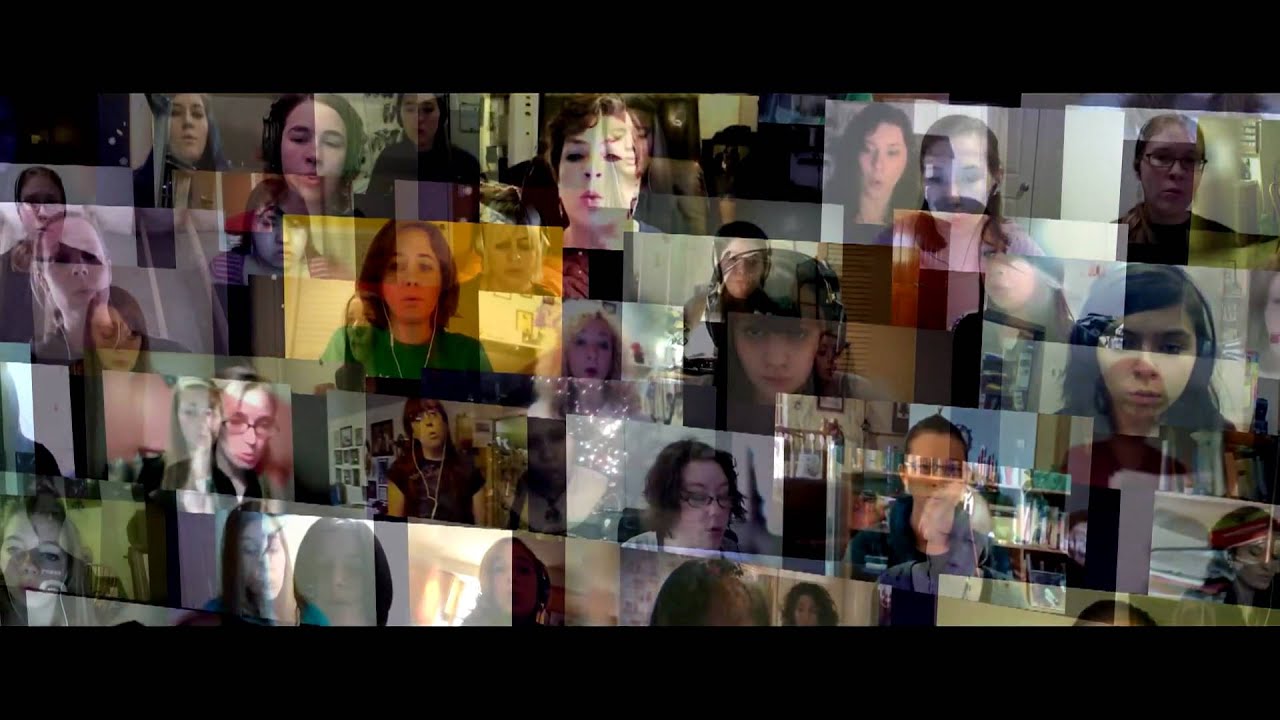
With an emergent technology, something happens that you’d never imagined. Here, YouTube and Hulu, via WordPress, Facebook, and Twitter — and built upon the Internet — bring something new and wonderful to life.
In a moving, madly viral video last year, composer Eric Whitacre led a virtual choir of singers from around the world. He talks through the creative challenges of making music powered by YouTube, and unveils the first 2 minutes of his new work, “Sleep.”